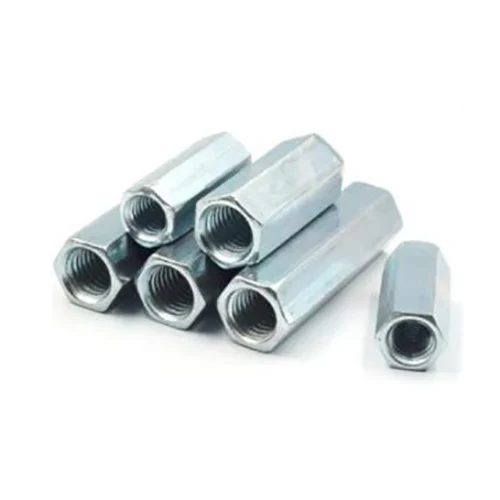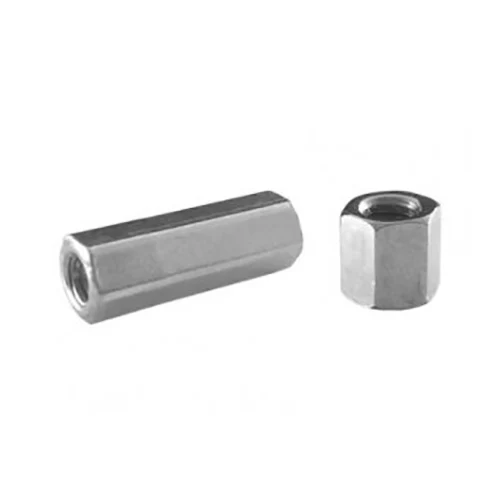

A hex coupling nut, also known as a rod coupling, is a type of nut that is used to connect two pieces of threaded material. Here is a detailed introduction:
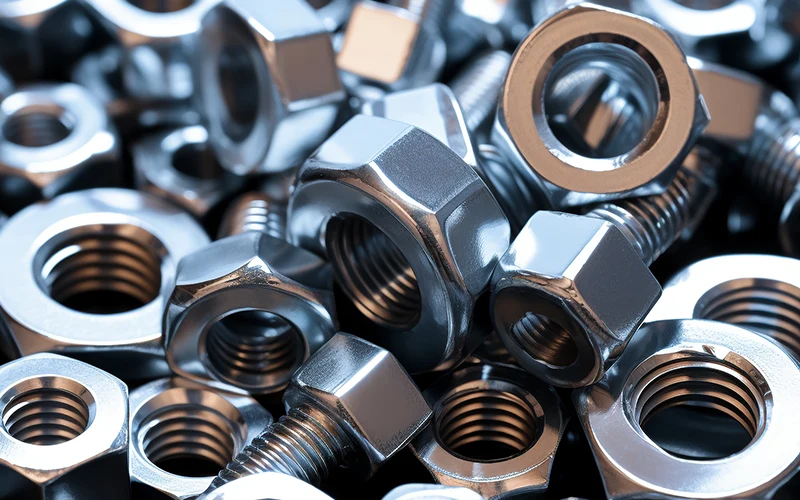
Structure and Shape: It is internally threaded and hexagonal in shape, similar to a regular hex nut. However, it is longer than a typical hexagonal nut. The length of the nut is greater than 2.5 times the basic major thread diameter. It usually has double chamfers at both ends, which helps to guide the threaded rods or bolts into the nut more easily.
Materials: Hex coupling nuts are available in a variety of materials, mainly including carbon steel, stainless steel, and alloy steel. Common stainless - steel types are 304 and 316. Stainless steel 304 contains 18% chromium and 8% nickel, offering good tensile strength and corrosion resistance in many moderately corrosive environments. Stainless steel 316 contains 16% chromium, 10% nickel, and 2 - 3% molybdenum, which enhances its corrosion resistance, especially in chloride environments, making it suitable for harsh environments such as marine and chemical - exposure industrial applications.
Dimensions and Specifications: They are available in both metric and inch sizing options. Dimensions include the width across flats, width across corners, and length or thickness of the nut. For example, for a 1/2 - inch hex coupling nut, the width across flats may be 11/16 inch, the width across corners may be 0.794 inch, and the length may be 1 3/4 inches. Different grades and standards have different dimensional requirements.
Applications: Hex coupling nuts are widely used in various industries. In the industrial field, they are often used to connect two externally threaded components of equal thread diameter and pitch, such as threaded rods, serving as rod couplings. They are also commonly seen in furniture manufacturing, electronic equipment production, and communication equipment installation, used to join and fasten various components.
Advantages: They provide a reliable connection, ensuring the stability and firmness of the connection between two threaded components. The hexagonal shape allows for easy operation with standard hexagonal tools, such as wrenches and sockets, facilitating installation and disassembly. In addition, the materials used have good strength and corrosion resistance, which can meet the requirements of different working environments.
1,Standard: DIN6334, ANSI/ASME
2,Thread: UNC,UNF
3,Material: Stainless Steel / Carbon Steel ,low carbon steel(mild steel), middle carbon steel, alloy steel, stainless steel (SS201, SS304, SS316),and brass, aluminium alloy.
4,SAE Class: 2,5.8 ASTM A194 2H. Metric from 4 to 10
5,Metric Size: M6 M8 M10 M12 M14 M16 M18 M20 M22 M24 M27 M30 M33
Inch size: 1/4”,3/8”,1/2”,5/8”,3/4”,7/8”,1”,1-1/4”,1-1/2”
6,Surface finish: Plain finish,Black ,Black Oxide, Black Zinc Coating,Hot Dip Galvanized(HDG), Zinc Plated, Yellow ZP,Brass coating, Nickle plated , Chrome plating, Dacromat, Geomet, etc.
7,Packing: 20-25kg Carton+Pallet (bulk packing OR small box packing)